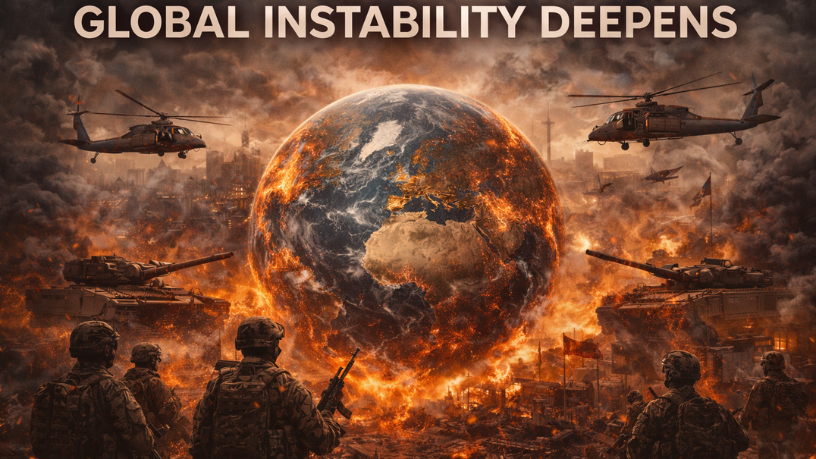

The world entered 2026 facing an increasingly fragile international landscape, as ongoing conflicts, economic uncertainty, and shifting alliances intensified global instability. According to reporting from AP News, governments across multiple regions are confronting overlapping crises rather than isolated challenges. Wars in Eastern Europe and the Middle East continue to dominate diplomatic agendas, while tensions in Asia and Latin America add pressure to an already strained global system. Analysts describe the current moment as one of cumulative risk, where events in one region quickly reverberate worldwide.
Economic uncertainty has become a central driver of global tension. Persistent inflation, volatile energy markets, and disruptions in global trade routes are forcing nations to reconsider long-standing economic strategies. AP News reports that many governments are prioritizing domestic stability over international cooperation, leading to a more fragmented global economy. Developing countries are particularly vulnerable, facing rising debt levels and limited access to financial support. These pressures are accelerating a shift away from globalization toward regional economic blocs.
Security concerns are also escalating as military spending rises across continents. From NATO countries to Asia-Pacific powers, governments are investing heavily in defense amid fears of broader confrontation. According to AP News, emerging technologies such as cyberwarfare, autonomous weapons, and space-based systems are reshaping how conflicts are planned and deterred. This evolution has complicated traditional arms control efforts and increased the risk of miscalculation. The global security environment is becoming more unpredictable and technologically driven.
Diplomatic institutions are struggling to manage these pressures. International organizations continue to convene emergency meetings and summits, but consensus has proven difficult to achieve. AP News notes that ideological divisions and strategic rivalry among major powers are limiting cooperation on issues such as climate change, migration, and humanitarian aid. Even when shared interests exist, trust between governments remains fragile. As a result, diplomacy is increasingly reactive rather than preventive.
Humanitarian crises are expanding alongside geopolitical tensions. Conflicts and economic collapse have displaced millions, placing additional strain on neighboring countries and aid organizations. AP News reports that humanitarian agencies are facing funding shortfalls at a time when demand for assistance is growing. Food insecurity, healthcare disruptions, and climate-related disasters are compounding the impact of war and political instability. These challenges highlight the interconnected nature of global crises.
From a U.S. perspective, American policymakers are reassessing their role in a rapidly changing world. AP News coverage emphasizes debates within Washington over military commitments, economic policy, and diplomatic engagement. The United States faces pressure to balance domestic priorities with international responsibilities. Allies are watching closely to see how U.S. leadership adapts to this evolving global environment. Decisions made in Washington are expected to carry significant global consequences.
Experts interviewed by AP News suggest that the world is entering a period of long-term strategic competition rather than short-term crisis management. Power is becoming more dispersed, and traditional hierarchies are weakening. This shift makes global coordination more difficult and increases the likelihood of regional instability. The rules-based international order, while not collapsing, is under sustained stress.
As 2026 unfolds, AP News reports that the central question facing world leaders is whether cooperation can be restored before instability deepens further. The convergence of conflict, economic strain, and political fragmentation presents one of the most complex global challenges in decades. How governments respond in the coming months will shape international relations for years to come.
Author: Vania Quimmer