
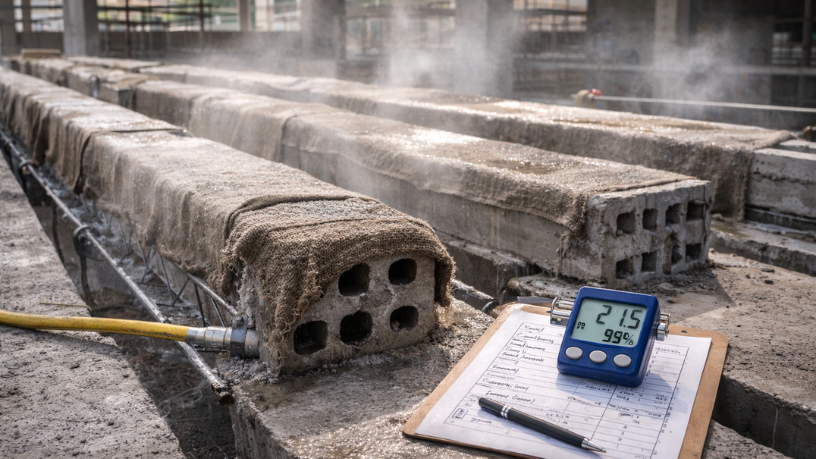

According to engineer Valderci Malagosini Machado, concrete curing is one of the most decisive stages for the final performance of both precast and cast-in-place elements. Although it is often underestimated, this phase directly influences strength, durability, and dimensional stability.
In this article, you will understand how curing affects the mechanical properties of concrete, which mistakes compromise the results, and which practices ensure superior quality. Continue reading and evaluate whether your processes are truly ensuring the expected performance.
What Is Concrete Curing and Why Is It Essential?
Concrete curing consists of controlling moisture and temperature after casting, allowing the cement hydration process to occur properly. According to technical principles widely adopted in engineering, hydration is responsible for the development of mechanical strength. Without sufficient water, this chemical reaction cannot be completed.
Early moisture loss causes excessive shrinkage and microcracking. These initial defects may evolve into more serious pathologies over time. Therefore, curing is not merely a complementary step but an integral part of the structural performance of concrete elements.
How Does Curing Influence Strength and Durability?
Concrete strength is directly linked to the continuity of the hydration process. According to well-established technical criteria, concrete subjected to proper curing gains greater strength in the days and weeks following casting. This means a higher capacity to withstand loads and a lower risk of cracking.
According to engineer Valderci Malagosini Machado, durability also depends on this initial care. When curing is insufficient, porosity increases, facilitating the penetration of aggressive agents. As a consequence, problems such as reinforcement corrosion and reduced service life may occur. Final quality therefore begins in the first days after concreting.
What Are the Main Curing Methods?
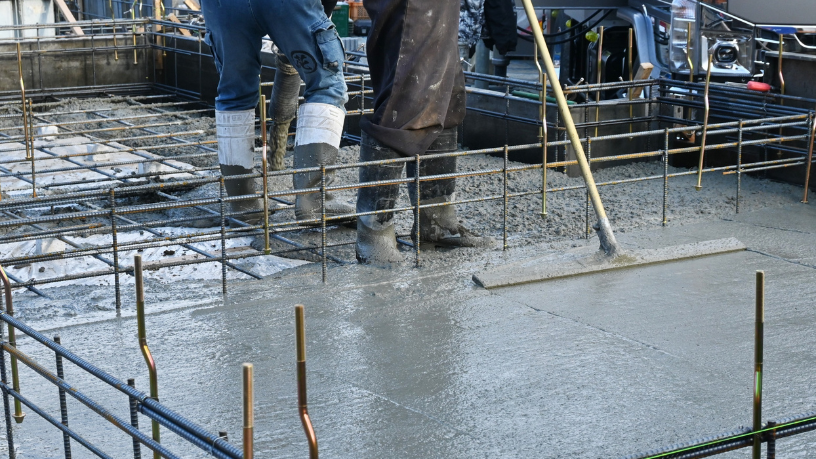
There are different curing methods, and the choice depends on the type of element, climate conditions, and production pace. Each technique aims to preserve moisture and control temperature to ensure efficient hydration.
Among the most commonly used methods are:
Wet curing through water spraying
Covering with blankets or plastic sheets
Application of chemical curing membranes
Controlled thermal curing in industrial environments
Each method has specific advantages. As engineer Valderci Malagosini Machado observes, the appropriate selection must consider operational feasibility and the technical requirements of the final product. The key objective is to ensure that hydration occurs without premature interruption.
What Mistakes Compromise Final Performance?
Failures in curing are often associated with rushing the release of elements or with the lack of environmental control. According to good production practices, removing protection too early significantly reduces the potential strength of the concrete. In addition, high temperatures without control accelerate water evaporation.
According to engineer Valderci Malagosini Machado, another common mistake is the belief that high-strength concrete does not require rigorous curing control. In practice, the greater the structural demand, the greater the need for control. Neglecting this stage can lead to cracks, warping, and dimensional variations that compromise the entire production batch.
How to Structure an Efficient Curing Process?
Implementing a standardized protocol is essential to guarantee consistent results. According to industrial quality criteria, control should involve monitoring time, humidity, and temperature. Periodic records make it possible to identify deviations and correct them quickly.
Team training is equally important, as highlighted by engineer Valderci Malagosini Machado. Well-trained operators understand the importance of curing and avoid improvisation. Furthermore, investing in proper infrastructure—such as covered areas and automated spraying systems—raises production standards and reduces losses.
The Foundation for Stronger and More Durable Concrete Elements
Ultimately, concrete curing defines the final performance of elements because it directly influences the formation of the material’s microstructure. When properly executed, it ensures higher strength, fewer cracks, and greater durability. It is a strategic stage, not merely an operational one.
Companies seeking excellence must treat curing as a technical priority. Planning, control, and discipline in meeting curing timelines are essential elements for achieving consistent results. By understanding that quality begins in the first days of concrete’s life, it becomes possible to deliver safer, more competitive, and more durable elements.
Author: Diego Rodríguez Velázquez