
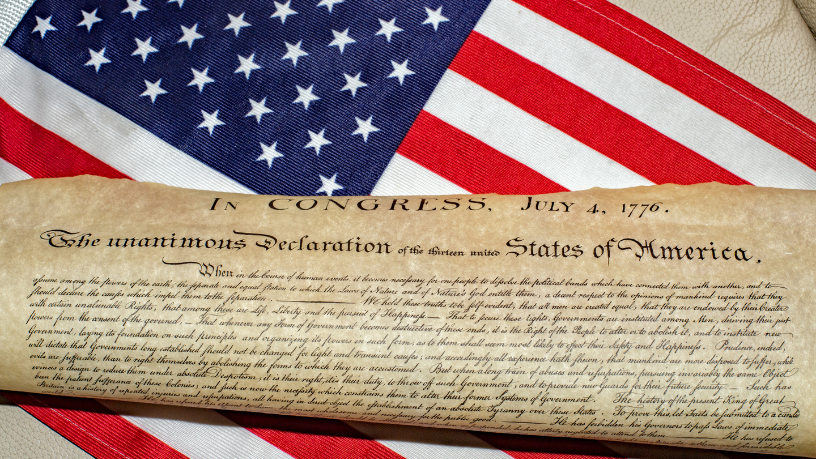

The transformation of the United States Declaration of Independence into a historic communication event reveals how information circulated in the 18th century and how the concept of “news” already had strong political and social impact. This article analyzes how the document drafted in 1776 moved from the Continental Congress in Philadelphia to the broader public, shaping perceptions, strengthening colonial political identity, and establishing an early model of official public communication.
In 1776, the political landscape in North America was in full rupture with British authority. In Philadelphia, political leaders gathered in the Continental Congress advanced the process of formalizing independence. In this context, the creation of the American Declaration of Independence, drafted with the central contribution of Thomas Jefferson and supported by figures such as John Adams and Benjamin Franklin, was not only a political act but also a major communication event for its time.
The main challenge was not only writing the document but ensuring it reached a vast territory with severe limitations in transportation and communication. The absence of modern technology meant that information spread relied on physical delivery networks, local printers, and public readings. Even so, political urgency demanded speed, and the message needed to reach the colonies quickly to secure support and prevent fragmented interpretations.
The circulation of the text occurred through widely distributed printed materials, especially newspapers and pamphlets known as broadsides. These materials were reproduced by local print shops, which played a crucial role in shaping public opinion. Within a few weeks, the document was being read in public spaces, churches, and civic gatherings, creating a collective mobilization effect that can be understood as a primitive form of “breaking news.” The message was not only informative but also performative, as public readings reinforced the legitimacy of the independence movement.
Printed media played a decisive role in transforming an institutional act into a social phenomenon. Colonial newspapers, still in development, competed for speed in publishing the text, while editors sought ways to attract readers with information that directly affected the political future of the colonies. This communication ecosystem helped establish the idea that political decisions should be immediately shared with the public, a principle that would later become fundamental to modern journalism.
The reception of the document varied between enthusiasm, caution, and resistance, depending on the region and its political alignment. In some communities, public readings sparked celebrations and symbolic acts of support for independence. In others, the content was met with concern about the consequences of a definitive break with the British Empire. This diversity of reactions shows that the circulation of information not only informed but also reorganized political and social positions in real time, within the constraints of the 18th century.
The impact of its dissemination also extended beyond the colonies. The news crossed the Atlantic and reached Europe, where it was analyzed by governments and political observers as a sign of instability within British control. This international flow of information reinforces the importance of the document not only as a legal milestone but also as a global communication event capable of shaping geopolitical perceptions far beyond its original context.
From a contemporary editorial perspective, parallels can be drawn between the circulation of the Declaration of Independence and today’s news dissemination dynamics. The speed at which information spreads today finds a historical precedent in this episode, even though the technologies are entirely different. What changes is not only the medium but also the scale and immediacy. Still, the need for narrative control, public interpretation, and competing versions was already present in 1776.
This historical episode also highlights how information has always been a form of power. Controlling printing and distribution effectively meant controlling how independence was understood. More than a political text, the Declaration became a tool of mass mobilization, whose effectiveness depended directly on communication capacity.
By analyzing this process, it becomes clear that the birth of the United States was closely tied not only to political decisions but also to how those decisions were communicated. The transformation of the Declaration of Independence into breaking news marked a turning point in the relationship between politics and information, laying foundations that still influence how modern societies understand the dissemination of historical events and state decisions.