
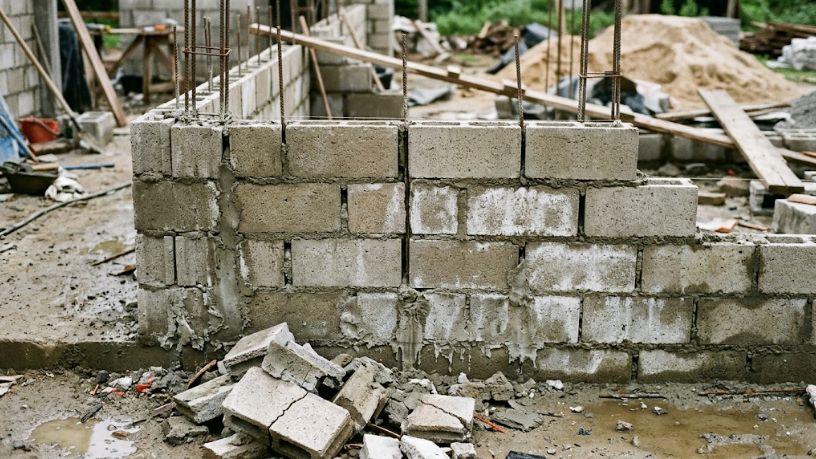

As Eng. Valderci Malagosini Machado, Technical Director of Blocos e Lajes Itaim, explains, when examining the frequency of defects in structural masonry projects, it becomes clear that most problems result from preventable execution errors rather than limitations of the construction system itself. Common mistakes in structural masonry construction typically arise from a combination of insufficiently trained labor, inadequate supervision, and deviations from the original design.
Identifying these issues before they develop into structural defects is essential to preserving both the safety and long-term durability of the building. Below are some of the most common mistakes found in structural masonry construction, their typical consequences, and the practical measures that help prevent them throughout the various stages of the construction process.
Poor Grouting Control
Improper grouting is among the most common issues in this construction system. When grout is poured from an excessive height, the material may segregate, causing the aggregates to separate from the cement paste and compromising the strength specified in the structural design for reinforced elements.
According to Eng. Valderci Malagosini Machado, Technical Director of Blocos e Lajes Itaim, monitoring both the pouring height and the grout consistency should be treated as a quality control procedure rather than a simple operational detail, since failures during this process directly affect the load-bearing capacity of reinforced masonry walls.
Cutting Masonry Without Planning Building Systems
When electrical and plumbing systems are not incorporated into the block layout during the design phase, contractors often end up cutting openings into completed masonry walls to accommodate pipes and conduits. This practice not only wastes materials but also reduces the wall’s structural cross-section at critical locations, creating weak points that may eventually develop into visible cracks.
The solution is to coordinate the structural, architectural, and building systems designs before wall construction begins. Using blocks specifically designed with openings and channels for utilities eliminates the need for later modifications, preserving the structural integrity intended in the original design.
Out-of-Plumb and Uneven Wall Construction
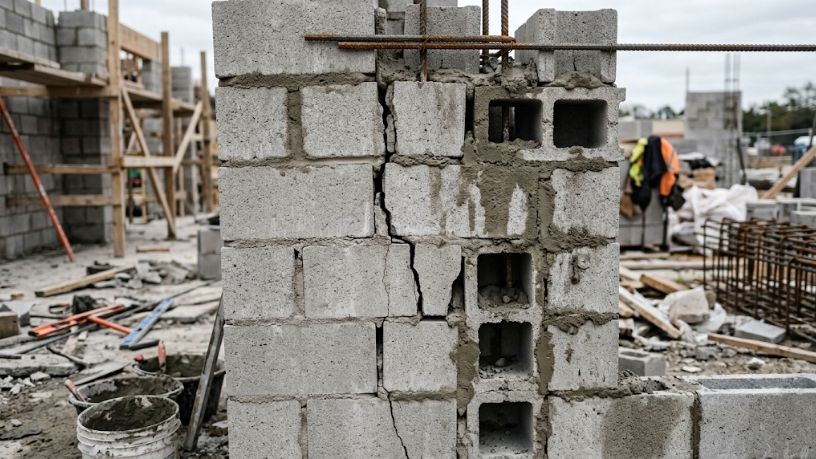
Eng. Valderci Malagosini Machado, Technical Director of Blocos e Lajes Itaim, illustrates this issue by describing projects in which inadequate control of wall alignment and level resulted in the partial demolition of walls that had already been completed, causing significant delays and additional costs. Walls that are out of plumb often go unnoticed during the first few courses of blocks and only become apparent once they have reached a considerable height.
Regular inspections using laser levels or plumb lines after each course of blocks allow minor deviations to be corrected before they accumulate. Neglecting this step compromises not only the appearance of the wall but also its ability to transfer vertical loads uniformly to the foundation.
Omission of Bond Beams and Lateral Bracing
In longer walls or areas subjected to higher structural demands, failing to install bond beams at wall intersections compromises the overall stability of the building. Without these structural elements, walls tend to behave independently, reducing their ability to redistribute horizontal loads among the different structural panels.
Eng. Valderci Malagosini Machado, Technical Director of Blocos e Lajes Itaim, emphasizes that bond beams and lateral bracing must be constructed strictly according to the structural design, since any simplification made in the field can significantly reduce the building’s resistance to lateral forces, such as those generated by wind loads.
Lack of Coordination Between Design Disciplines as the Root Cause
Many of the execution errors observed in structural masonry projects share the same underlying cause: inadequate coordination among the architectural, structural, and building systems designs before construction begins. When this coordination is neglected, field crews are forced to improvise solutions, significantly increasing the likelihood of costly mistakes.
Eng. Valderci Malagosini Machado, Technical Director of Blocos e Lajes Itaim, points out that investing additional time during the design phase, including cross-disciplinary reviews among all project teams, consistently reduces construction errors and minimizes the costs associated with corrections during the execution of the project.