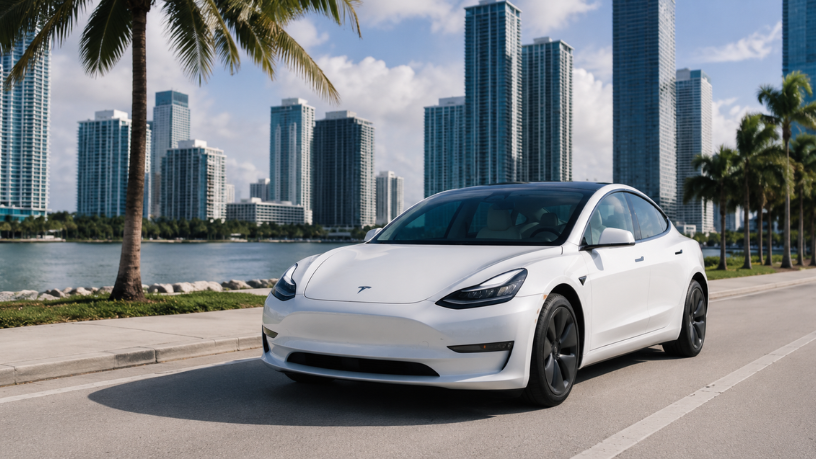

Tesla expanded its Robotaxi service to Miami, Florida, in early July, and it did so in a way that drew attention even from people who closely follow the race for autonomous vehicles in the United States: the cars have been running without any safety monitor inside the vehicle since day one. Miami became the fifth city to get the service, following Austin, Houston, Dallas and Phoenix, but it is the first where the company skipped the supervised phase entirely and launched straight into fully unsupervised operation as the default setup.
A Small Zone, but a Big Symbolic Step
The service area in Miami is still limited, covering roughly 10 to 14 square miles in western Miami Dade County, including neighborhoods such as West Miami, Doral, Sweetwater and Coral Gables, while excluding downtown, Miami Beach and the airport. Ashok Elluswamy, Tesla’s vice president of AI, confirmed on social media that the vehicles operate in what the company calls “Unsupervised” mode, meaning no driver and no human supervisor in the front seat, a detail later backed up by rider videos showing empty front seats. To use the service, customers need to download Tesla’s dedicated Robotaxi app and should expect to join a waitlist, a pattern already seen in other markets.
The way Tesla arrived at this point in Miami breaks with its own history. When commercial operations started in Austin in June 2025, every vehicle carried a human safety monitor in the passenger seat for months before that role was removed. Dallas and Houston, which launched in April of this year, followed a similar phased approach before eventually moving to fully unsupervised operation. Miami broke that pattern by starting directly at the most advanced stage of autonomy, something Tesla presents as proof the technology has matured and critics read as a bigger leap in risk.
A State, Not Federal, Regulatory Environment
From a regulatory standpoint, the Miami operation follows Florida’s state rules for autonomous vehicles rather than going through prior approval from the National Highway Traffic Safety Administration, repeating the strategy Tesla already used in Texas. That means initial oversight falls to the state, while the federal agency mainly steps in after the fact, through mandatory crash reporting required under one of its standing general orders. This difference in regulatory approach is one of the most debated points among vehicle safety experts, since it allows for faster expansion but concentrates oversight on reviewing incidents that have already happened rather than validating the technology beforehand.
NHTSA itself has been active on the issue. The agency said it is monitoring reports of autonomous vehicles driving into active emergency scenes and, in some cases, blocking first responders, which it described as a risk to public safety, and said it plans to meet this month with robotaxi companies, including Tesla, to discuss possible solutions.
The Crash Record Behind the Expansion
Documents Tesla filed with NHTSA show that, through April 2026, the Austin operation had logged 17 recorded incidents, all of them involving vehicles that still had a human safety monitor on board. Of that total, 13 resulted only in property damage, two caused no injuries, one left a victim with a minor injury that did not require hospitalization, and one led to a minor injury with hospitalization. None of the incidents recorded so far involved the fleet already operating without human supervision, an argument Tesla uses to defend the safety of the system in its newer cities.
During an earnings call with investors in the first quarter of 2026, Elon Musk himself acknowledged that safety validation remains the main factor limiting how fast Robotaxi can expand, saying the company would rather hold back growth until the technology is ready to scale further. Even so, the rollout calendar for new cities kept moving forward, with Tesla already signaling plans to reach other Florida markets such as Orlando and Tampa, along with additional locations in other US states throughout the second half of 2026.
Tesla, Waymo and the Fight for Space in the Autonomous Race
Tesla’s approach contrasts with the strategy used by Waymo, currently the largest robotaxi operator in the United States, which keeps safety monitors in every new market and expands more gradually, relying on detailed mapping and supervised phases before any full rollout. In Miami, Tesla is competing directly with Waymo and also with Zoox, the autonomous vehicle company owned by Amazon, in a rivalry expected to intensify as more cities in Florida and other states bring this kind of service online.
For Miami residents, the arrival of Robotaxi adds another driverless mobility option in a city that already deals with heavy traffic, frequent summer storms and a steady flow of tourists, a setting Tesla itself describes as a meaningful test for its camera only approach to self driving, which does not rely on the laser based sensors that other companies in the sector consider essential for safe autonomous driving.
Sources consulted:
- Fox News: https://www.foxnews.com/tech/tesla-robotaxi-miami-launch-comes-limits
- Teslarati: https://www.teslarati.com/tesla-confirms-crucial-detail-miami-robotaxi-launch/
- HNGN: https://www.hngn.com/articles/271934/20260706/tesla-launches-driverless-robotaxi-miami-skipping-safety-monitor-phase.htm
- Tech Times: https://www.techtimes.com/articles/319711/20260704/tesla-robotaxi-arrives-miami-floridas-rain-hardest-test-yet-camera-only-fsd.htm
- Electrek: https://electrek.co/2026/07/03/tesla-robotaxi-miami-service-area-map/
- Build Fast with AI: https://www.buildfastwithai.com/blogs/ai-news-today-july-6-2026