


Aviation has long attracted professionals from other fields, and the experience of businessman and pilot Wander Aguilera Almeida illustrates the demands this choice places on personal organization. A private pilot license requires continuous study, logged flight hours, periodic medical examinations, and a level of consistency that can be difficult to maintain with a busy schedule. None of this can be accomplished through an intensive weekend course.
Flying for leisure does not mean taking an informal approach. Training follows regulated stages, including theoretical coursework, practical instruction, and a proficiency examination. The material requires frequent reading and constant review. Maintaining the license depends on requirements that do not change according to the student’s availability, which can discourage those who expected a quick weekend course.
The Stages of Private Pilot Training
The process begins with theoretical coursework covering air traffic regulations, meteorology, navigation, aircraft technical knowledge, and human performance. After passing the examination administered by the Civil Aviation Authority, the student proceeds to practical instruction at an aeroclub or approved flight school, where each flight has a defined objective and is evaluated by an instructor. The required minimum flight hours include cross-country navigation and solo flying.
In Wander Aguilera Almeida’s view, the theoretical component often surprises those who imagine pilot training as little more than learning to handle the controls, because understanding navigation charts and aircraft performance limitations is just as important as developing the ability to land accurately. Knowing why an aircraft flies changes the way it is operated. Weak theoretical foundations become apparent as early as the first simulated emergency during training.
Scheduling Discipline and Continuous Study
According to Wander Aguilera Almeida, balancing flight instruction with a business routine requires weekly planning, since weather conditions, instructor availability, and aircraft maintenance schedules must align at the same time. A lesson takes place when all three factors come together, not simply when a gap opens up in the calendar. Booking in advance helps prevent an entire week from being lost.
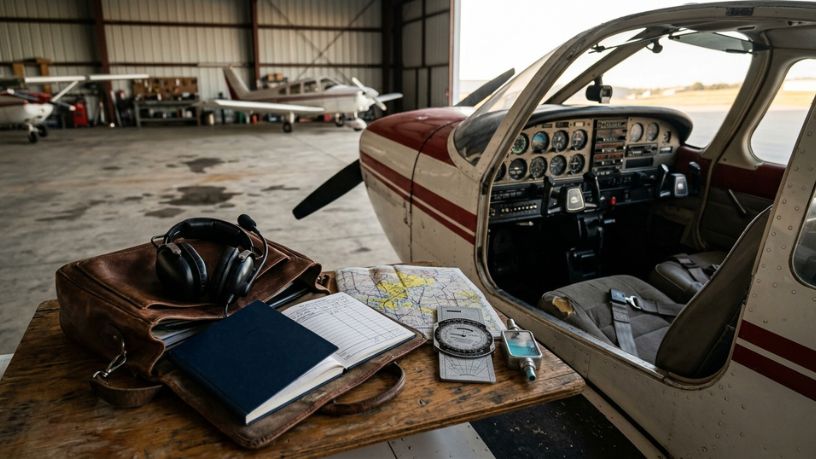
Lessons canceled because of a low cloud ceiling or strong crosswinds are part of the process. Those who approach their schedules with flexibility make more consistent progress because they maintain their study routine even during weeks when the aircraft never leaves the hangar. Reviewing procedures on the ground also counts as progress, since studying navigation charts and reviewing checklists help keep decision-making skills sharp.
What Flying Teaches About Decision-Making
Before any takeoff, a sequence of checks must be completed. Weight and balance calculations, fuel planning with an adequate reserve, a thorough aircraft inspection, and an assessment of conditions at the destination aerodrome all precede the request for taxi clearance. Skipping a step rarely causes an immediate problem, and that is precisely the trap: habits developed during uneventful flights support sound decisions when conditions become challenging.
As Wander Aguilera Almeida points out, the habit of making decisions based on checklists and objective data eventually influences professional life, because considering what to do if circumstances change becomes part of the process before taking action, rather than after a problem has already developed. Planning an alternative costs little on the ground. Improvising in the cockpit can be costly at any stage of flight, from taxiing to landing.
Safety as a Routine, Not an Exception
In Wander Aguilera Almeida’s view, respecting operational limits is the least negotiable aspect of flying, because private flights do not involve commercial deadlines, and canceling remains the safest decision whenever any part of the flight plan does not add up. No destination justifies taking off with unresolved doubts about the weather, and waiting two hours on the ground is far better than trying to manage the situation en route.
Logged flight hours, up-to-date aircraft maintenance, and a valid aviation medical certificate form the foundation of responsible flying. The enjoyment of flying and compliance with regulations go hand in hand, since the freedom to fly depends precisely on the rigor that comes beforehand, in the pages of the manual and during the hangar inspection. Responsible practice is measured by the consistency of records and reviews.