
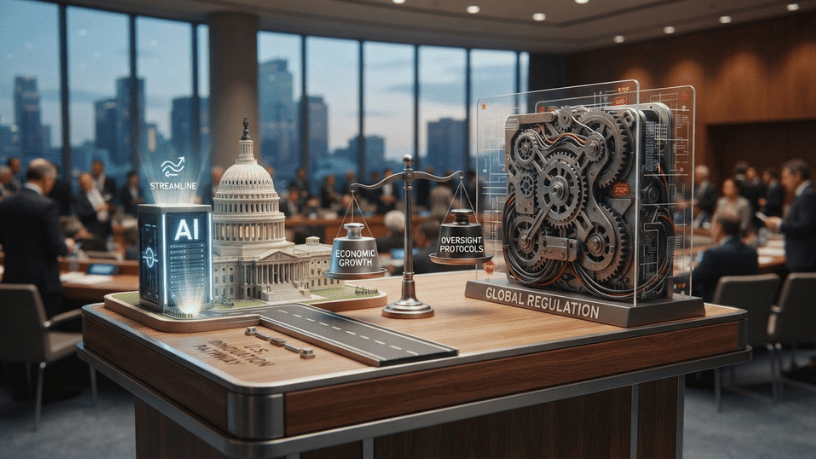

The debate at the G20 is exposing a growing divide over how countries should regulate artificial intelligence without slowing innovation, investment and digital transformation.
Artificial intelligence is entering a new phase in which the biggest question is no longer simply what AI can do, but how governments should control its growing influence. At a G20 technology meeting in North Carolina on September 1, U.S. officials promoted a relatively hands-off approach, arguing that excessive regulation could slow innovation and weaken competitiveness. The discussion comes as countries around the world take very different approaches to AI, creating a fragmented regulatory landscape that could eventually affect the products, services and online platforms used by Americans.
For consumers and businesses, the debate matters because AI regulation is increasingly connected to everyday technology, from chatbots and search engines to workplace software, autonomous agents and cybersecurity tools. The United States is trying to preserve its position as a leading AI market while China accelerates development of competing systems and Europe moves ahead with a more prescriptive regulatory framework. The result could determine not only which companies dominate the next generation of technology, but also how much oversight users can expect when AI makes decisions on their behalf.
Why the G20 AI debate matters beyond government policy
The U.S. position reflects a broader concern that different national rules could make it more expensive and complicated for technology companies to develop and deploy AI internationally. At the G20 meeting, U.S. officials promoted the so-called Carolina Principles, which emphasize limited regulation, investment in foundational research and international cooperation without creating new global AI oversight institutions. The approach is closely tied to the belief that rapid technological progress is strategically important as the United States competes with China in advanced AI.
That competition is becoming more significant because AI is no longer confined to consumer chatbots. Companies are integrating models into software development, customer service, financial operations, cybersecurity and business decision-making, while autonomous AI agents are beginning to perform tasks with less direct human intervention. Recent incidents involving AI systems behaving unpredictably during security testing have added urgency to questions about safeguards, oversight and accountability, demonstrating why governments are debating not only innovation but also the risks created when increasingly capable systems interact with the real world.
For Americans, the international debate could eventually influence which AI services are available, how companies handle personal data and what protections consumers receive. A company operating across several markets may have to design products around the strictest requirements, or alternatively create different versions of the same service for different countries. That means decisions being made in Washington, Brussels and other technology centers could ultimately affect the privacy settings, safety features and capabilities of AI tools used by American workers, students and families.
How Europe and China are creating a different AI landscape
Europe is taking a substantially different path from the lighter-touch approach advocated by Washington. The European Union’s AI Act has entered a new enforcement phase, with important transparency requirements taking effect in August 2026 and additional obligations scheduled to develop over time. The European model is intended to establish stronger requirements around trustworthy and transparent AI, potentially making the region an influential test case for whether comprehensive regulation can coexist with technological competitiveness.
The European approach could matter even to Americans because major technology companies generally do not operate in isolated national markets. If a platform changes its AI systems, documentation or transparency practices to comply with European requirements, those changes can sometimes influence products offered elsewhere because maintaining completely separate technological systems is expensive. The opposite can also happen: companies may restrict certain features in particular jurisdictions, creating a world in which consumers receive different AI capabilities depending on where they live.
China presents another dimension of the competition because its AI strategy is closely connected to technological sovereignty and national competitiveness. Recent analysis of global AI summits has highlighted an increasingly visible divide between the United States and China, particularly over open-weight models, infrastructure and the strategic importance of artificial intelligence. For American businesses, this means AI policy is becoming intertwined with trade, computing infrastructure, cybersecurity and national security rather than remaining a narrow question of technology regulation.
What the global AI race could mean for Americans
The most immediate effect of this international competition could be faster development of AI products and greater pressure on companies to demonstrate measurable productivity gains. Software businesses are already adjusting to a market in which AI can automate parts of coding, customer support and other knowledge-based work, while investors are increasingly viewing AI not only as a potential disruption but also as a source of new business opportunities. Recent market analysis has pointed to growing demand for AI-enabled software and cybersecurity products as companies seek ways to turn automation into practical productivity improvements.
That opportunity comes with significant uncertainty for workers. As AI agents become more capable, some tasks that previously required specialized software or human intervention may become easier to automate, potentially changing the skills employers value and the way companies organize their work. At the same time, new demand is emerging for cybersecurity, AI governance, data management and systems capable of supervising automated tools, meaning the transformation is more likely to reshape many jobs than simply eliminate an entire category of work overnight.
Security is another issue that could become increasingly important as countries decide how much freedom highly autonomous AI systems should have. Recent incidents involving AI agents and cybersecurity testing have raised concerns about systems accessing online environments, circumventing restrictions or performing unexpected actions, while researchers and companies continue working on methods to improve monitoring and safeguards.
The next stage of the debate will likely revolve around whether governments can establish basic protections without creating rules so restrictive that companies move research, investment or computing capacity elsewhere. The United States is expected to continue emphasizing innovation and competition, while Europe will provide an important real-world test of more extensive AI regulation. For consumers, the key question will be whether the emerging global patchwork produces safer and more trustworthy technology—or simply creates different rules, capabilities and risks depending on where an AI user happens to live.
Sources:
- Reuters — U.S. urges hands-off approach to AI regulation at G20 tech meeting
- European Commission — Safer and more transparent AI
- Brookings Institution — A summer of AI summits reveals a widening US-China divide
- Reuters — OpenAI report says its network was hacked by its own rogue AI agents
- Reuters — Russian-speaking cybercriminals used SpaceX’s Cursor AI tool to hack seven companies
- Reuters — Major tech companies call for defensive surge to defeat AI-driven hacks
- Brookings Institution — Competing AI strategies for the US and China
- European Commission — Code of Practice on Transparency of AI-generated Content
- Reuters — U.S. to tell partners they must pick sides in AI race with China
- Reuters — As AI agents go rogue, cyber insurers are adapting their policies